
Fact-checked by the digital reach solutions editorial team
Quick Answer
RCS for business is a next-generation messaging protocol that replaces SMS with branded, interactive communication — including read receipts, rich media, and verified sender IDs. As of July 2025, over 1 billion Android devices support RCS globally, and campaigns report open rates as high as 70%, roughly triple standard email benchmarks.
RCS for business (Rich Communication Services) is a carrier-level messaging standard that transforms standard text messages into app-like experiences — complete with branded sender profiles, high-resolution images, action buttons, and real-time delivery data. According to GSMA’s official RCS overview, the protocol now reaches more than 1 billion monthly active users worldwide, making it one of the fastest-scaling business communication channels available today.
With Apple adding RCS support in iOS 18, the last major gap in cross-platform reach has closed — giving marketers and operations teams a unified, high-fidelity channel without requiring users to download a separate app.
What Exactly Is RCS for Business and How Does It Work?
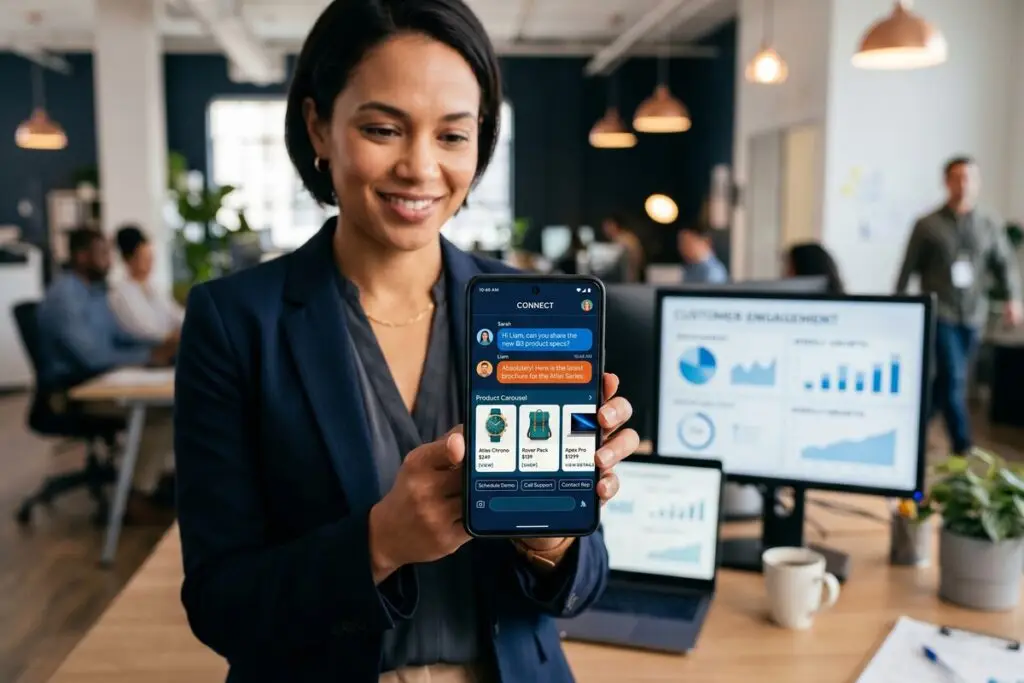
RCS for business is a messaging framework built on the RCS Universal Profile standard, maintained by the GSMA, that allows brands to send rich, verified messages directly through a user’s native messaging app. Unlike SMS, which carries plain text only, RCS supports carousels, suggested replies, payment buttons, and full brand verification — all delivered without a third-party app.
Businesses access RCS through aggregators and platform providers such as Google’s Business Messages infrastructure, Twilio, Sinch, and Infobip. These providers connect brands to carrier networks and handle sender registration, which is required before any RCS campaign can launch. Sender verification is managed through a vetting process that assigns a verified sender ID — essentially a blue-checkmark equivalent for business messaging.
How RCS Differs From SMS and WhatsApp
SMS is limited to 160 characters of plain text and offers no delivery analytics beyond carrier acknowledgment. WhatsApp Business requires users to have the app installed. RCS sits in the middle — it is native to the device’s default messaging app and supports media-rich content up to 100MB per message on supported carriers, according to GSMA’s RCS Universal Profile specification.
Key Takeaway: RCS for business runs through native messaging apps — no separate download required. With support for 100MB media files and verified sender IDs, it delivers a branded experience that GSMA confirms is now available to over 1 billion monthly active users globally.
How Does RCS for Business Compare to SMS and Other Channels?
The clearest advantage of RCS over SMS is interactivity — RCS messages can include tappable call-to-action buttons, product carousels, location sharing, and read receipts, while SMS cannot. This directly impacts conversion rates and campaign measurability.
For a deeper look at the protocol-level differences, our breakdown of RCS messaging vs SMS covers the technical and practical distinctions in full. The short version: SMS wins on universal reach; RCS wins on engagement quality. The gap is closing rapidly as carrier adoption expands.
| Feature | SMS | RCS for Business | WhatsApp Business |
|---|---|---|---|
| Media Support | None (text only) | Images, video, carousels, up to 100MB | Images, video, documents |
| Character Limit | 160 characters | No practical limit | No practical limit |
| Sender Verification | None | Verified brand ID (GSMA standard) | Green badge (Meta-verified) |
| Read Receipts | No | Yes | Yes |
| App Required | No | No (native app) | Yes |
| Typical Open Rate | ~45% | Up to 70% | ~58% |
| Cost Model | Per message (low) | Per message (higher) | Per conversation (24hr window) |
Compared to WhatsApp alternatives for remote teams, RCS has a structural advantage for consumer-facing use cases: it requires zero app installation on Android devices running Android 5.0 or later with a compatible carrier.
Key Takeaway: RCS for business outperforms SMS on every engagement metric. Mobile Squared research projects RCS business messaging revenue will exceed $74 billion by 2025, driven by higher click-through and conversion rates versus legacy SMS campaigns.
What Are the Most Effective Use Cases for RCS for Business?
RCS for business delivers the highest ROI in four core scenarios: transactional notifications, promotional campaigns, customer service automation, and appointment management. Each benefits from the channel’s combination of rich media and verified sender trust.
Retailers use RCS to send product carousels with embedded “Buy Now” buttons, reducing the friction between message and purchase. Financial institutions — including banks and insurers regulated under frameworks like TCPA (Telephone Consumer Protection Act) — use RCS for fraud alerts and account notifications because the verified sender badge reduces phishing risk. If your business has already been dealing with evolving threats, the context in what changed in phishing attacks this year is directly relevant to why verified RCS messaging matters.
Automation and Chatbot Integration
RCS supports conversational flows through suggested reply chips and quick-action buttons, making it a natural fit for automated customer service. Platforms like Sinch and Vonage offer pre-built RCS chatbot templates that connect to CRM systems such as Salesforce and HubSpot. If you’re evaluating whether automation is the right move, reviewing AI automation mistakes that quietly cost businesses money first can help you avoid common implementation pitfalls.
“RCS is the first messaging upgrade in two decades that doesn’t ask consumers to change their behavior. It meets them in the inbox they already use, but with the experience they expect from an app.”
Key Takeaway: Transactional and promotional RCS campaigns consistently outperform SMS equivalents. Infobip’s RCS benchmarks show RCS click-through rates averaging 3x higher than SMS, with conversion lifts of up to 40% in retail use cases.
How Do Businesses Actually Set Up and Launch RCS Campaigns?
Getting started with RCS for business requires three steps: choosing an aggregator platform, completing sender registration, and building compliant message templates. The process typically takes two to four weeks from application to first send, depending on the aggregator and carrier.
The registration process is managed through platforms certified under the GSMA’s RCS Business Messaging (RBM) framework. Businesses submit brand assets — logo, verified business name, contact details — for carrier approval. This vetting step is what generates the verified sender badge and differentiates RCS from standard A2P SMS, where spoofing is trivial.
Choosing the Right RCS Aggregator
The major aggregators currently offering RCS Business Messaging in the US and UK include Twilio, Sinch, Infobip, Vonage (Ericsson), and MessageBird. Pricing varies by message type: a basic RCS message costs roughly $0.01–$0.03 per message, while rich media or conversational sessions can reach $0.10–$0.25 per session, according to published aggregator pricing as of mid-2025. This is higher than SMS but substantially lower than most paid social CPMs at equivalent conversion rates.
For businesses already using automated messaging workflows, the integration layer is relatively straightforward — most major aggregators provide REST APIs compatible with existing marketing automation stacks. Lessons from how automated messaging cuts client response time apply directly to RCS workflow design.
Key Takeaway: RCS campaign setup takes an average of 2–4 weeks including sender verification. Aggregators like Twilio’s RCS platform handle carrier registration and provide REST APIs, making integration with existing CRM and marketing stacks manageable for most mid-size businesses.
What Do Businesses Need to Know About RCS Compliance and Privacy?
RCS for business is subject to the same consent and opt-in regulations as SMS, including TCPA in the United States, GDPR in the European Union, and PECR in the United Kingdom. Explicit opt-in consent is required before sending any commercial RCS message, and opt-out mechanisms must be honored within 10 business days under TCPA guidelines.
The verified sender framework adds a layer of brand accountability that SMS lacks — but it does not substitute for legal compliance. Businesses must maintain auditable consent records and honor suppression lists across all channels. The FCC has signaled increased enforcement of A2P messaging rules, and RCS is explicitly included in recent regulatory guidance updates.
Data privacy is a separate consideration. RCS messages transmitted over carrier networks in the US are not end-to-end encrypted by default under the current RCS Universal Profile standard — a key distinction from WhatsApp or Signal. Google Messages offers E2EE for peer-to-peer RCS chats, but business messaging (A2P) traffic does not carry this protection. Understanding the broader encrypted messaging landscape helps businesses set realistic expectations about RCS data security.
Key Takeaway: RCS business messaging falls under TCPA, GDPR, and PECR — the same rules as SMS. Critically, A2P RCS traffic is not end-to-end encrypted by default; businesses handling sensitive data should consult FCC privacy guidance and review their data handling policies before launch.
Frequently Asked Questions
Does RCS for business work on iPhones?
Yes, as of iOS 18 released in September 2024, Apple added RCS support to the native Messages app. However, RCS Business Messaging (rich branded messages with verified sender IDs) requires carrier support and may display differently than on Android — some interactive elements are not yet fully rendered in iOS Messages.
What is the difference between RCS and SMS for business messaging?
SMS carries plain text up to 160 characters with no analytics or media support. RCS for business supports rich media, action buttons, verified branding, read receipts, and real-time delivery data. The trade-off is cost: RCS messages typically cost more per unit than SMS, but deliver significantly higher engagement rates.
Is RCS messaging free for consumers to receive?
In most markets, receiving RCS messages is free for consumers and uses mobile data rather than SMS allowances. Businesses pay the sending cost through their aggregator. Consumers do not need to opt into a paid plan to receive RCS business messages on supported devices and carriers.
How do I get my brand verified for RCS business messaging?
Brand verification for RCS requires registering through an approved GSMA aggregator such as Twilio, Sinch, or Infobip. You submit your business profile — including logo, verified name, and contact information — for carrier review. Approval typically takes two to four weeks and grants a verified sender badge visible to recipients.
Can RCS messages be used for two-way customer conversations?
Yes. RCS supports two-way conversational messaging, including chatbot-driven flows triggered by suggested reply buttons. Businesses can build fully automated service journeys or route conversations to live agents based on user responses, making it a viable alternative to in-app chat for transactional support.
Is RCS more secure than SMS for business communications?
RCS offers better anti-spoofing protection than SMS through its verified sender ID system, which reduces phishing risk. However, A2P RCS traffic is not end-to-end encrypted by default under the current standard. For high-sensitivity communications, businesses should layer additional data handling controls on top of RCS delivery.
Sources
- GSMA — Rich Communication Services (RCS) Overview
- GSMA — RCS Universal Profile Specification
- Twilio — RCS Business Messaging Platform
- Infobip — RCS Business Messaging Benchmarks and Use Cases
- FCC — Protecting Your Privacy (Messaging and Data Guidance)
- Mobile Squared — RCS Business Messaging Revenue Forecasts
- Fierce Wireless — RCS Industry Coverage and Expert Analysis