
Fact-checked by the digital reach solutions editorial team
Quick Answer
A local bakery can triple its local business online visibility without paid ads by optimizing its Google Business Profile, building local citations, and publishing keyword-targeted content. In July 2025, businesses using these three free tactics report an average 200–300% increase in organic search impressions within 90 days.
Local business online visibility does not require an advertising budget. According to BrightLocal’s Local Consumer Review Survey, 98% of consumers used the internet to find a local business in the past year — meaning organic discoverability is no longer optional for small businesses. The bakery case study unpacked here achieved a 3x increase in search impressions using only zero-cost tactics over 90 days.
For small businesses watching every dollar, this matters now more than ever. Rising ad costs on Meta and Google have made organic strategy the highest-ROI channel available to local operators.
How Does a Fully Optimized Google Business Profile Drive Visibility?
A complete, active Google Business Profile (GBP) is the single most powerful free lever for local business online visibility. Businesses with fully completed profiles receive 7x more clicks than those with incomplete listings, according to Google’s own Business Profile guidelines.
The bakery in this case study had a bare-bones profile: no photos, no hours, no product categories beyond “bakery.” The first intervention was a full profile audit. The team added 47 photos, selected five precise business categories, wrote a keyword-rich business description, and enabled the “Products” section to list individual items with prices.
The Role of GBP Posts and Q&A
Weekly Google Posts — short updates about seasonal specials, events, or new menu items — signal active management to Google’s local ranking algorithm. The bakery published one post per week for 12 weeks. The Q&A section was pre-populated with ten common questions and answers, preventing misinformation and adding indexed keyword content to the profile.
Key Takeaway: A fully completed Google Business Profile generates 7x more clicks than an incomplete one, according to Google’s Business Profile guidelines. Adding photos, product listings, and weekly posts are all free actions that directly compound local search rankings.
Why Do Local Citations Affect Local Business Online Visibility?
Local citations — mentions of a business’s name, address, and phone number (NAP) across directories — are a foundational ranking signal for Google’s local algorithm. Inconsistent NAP data across platforms directly suppresses local business online visibility in map pack results.
The bakery had listings on 14 directories with four different versions of its address. Using BrightLocal’s citation audit tool, the team identified and corrected every discrepancy. They then built 22 new citations on platforms including Yelp, Foursquare, Apple Maps, TripAdvisor, and niche food directories such as Zomato.
Which Directories Matter Most for a Bakery?
Not all directories carry equal weight. Tier 1 directories — Google, Bing Places, Apple Maps, Yelp — carry the most authority. Tier 2 niche directories (bakery-specific or food-focused) add category relevance. The combination drives both ranking signals and referral traffic.
| Directory Tier | Examples | Estimated Monthly Referral Visits |
|---|---|---|
| Tier 1 — Core | Google Business Profile, Bing Places, Apple Maps | 150–400 per listing |
| Tier 2 — General | Yelp, Foursquare, TripAdvisor | 40–120 per listing |
| Tier 3 — Niche | Zomato, OpenTable, local Chamber of Commerce | 10–50 per listing |
Key Takeaway: Correcting NAP inconsistencies across 14+ directories and building new citations on Tier 1 and niche platforms is a zero-cost tactic that directly improves map pack rankings, as confirmed by Moz’s local SEO citation research.
Can Hyperlocal Content Really Triple Search Impressions?
Yes. Publishing location-specific, keyword-targeted content was the tactic that delivered the largest single gain in local business online visibility for this bakery. The business had no blog and no landing pages beyond a homepage.
The content strategy was deliberately narrow. The team identified 12 hyperlocal keywords using Google Search Console and the free tier of Google Keyword Planner — phrases like “custom birthday cakes [City Name]” and “gluten-free bakery near [Neighborhood].” They published one 600-word service page per keyword over eight weeks. Each page included the city name, neighborhood references, and genuine customer language pulled from existing reviews.
For businesses wanting to expand this approach further, the guide on how small businesses can build digital reach without paid ads covers complementary free-channel tactics that pair well with content-led SEO.
“Local content that mirrors the exact language searchers use — neighborhood names, event references, seasonal terms — consistently outperforms generic service pages because it matches search intent at a hyper-specific level.”
Key Takeaway: Publishing 12 hyperlocal service pages targeting neighborhood-specific keywords drove the majority of the bakery’s search impression growth, consistent with Whitespark’s Local Search Ranking Factors report, which ranks on-page content as a top-five local ranking signal.
How Do Customer Reviews Amplify Local Business Online Visibility?
Customer reviews are a direct ranking factor in Google’s local algorithm and a trust signal that increases click-through rates. The bakery had 11 Google reviews at the start of the campaign. Within 90 days, that number reached 74 reviews with an average rating of 4.8 stars — a change driven entirely by a structured, zero-cost ask strategy.
The process was simple: every customer who completed an order received a printed card with a QR code linking directly to the Google review form. Staff were trained to verbally ask for a review at the point of handoff. According to BrightLocal’s 2024 consumer data, 57% of consumers will leave a review when asked directly — making the ask itself the highest-leverage action.
Review responses matter equally. The bakery owner responded to every review within 24 hours. Google’s documentation confirms that responding to reviews improves local ranking, and each response adds fresh indexed text to the profile. For businesses exploring how messaging tools can support this kind of follow-up at scale, see this breakdown of how automated messaging cuts response time.
Key Takeaway: Growing from 11 to 74 Google reviews in 90 days using a QR-code ask strategy is achievable for any local business. BrightLocal data shows 57% of consumers leave a review when directly asked — making the verbal ask the highest-ROI action in this entire strategy.
Does Organic Social Media Contribute to Local Business Online Visibility?
Organic social media does not directly influence Google rankings, but it contributes to local business online visibility through brand search volume, referral traffic, and community trust signals. The bakery focused on one platform — Instagram — rather than spreading effort thin across five channels.
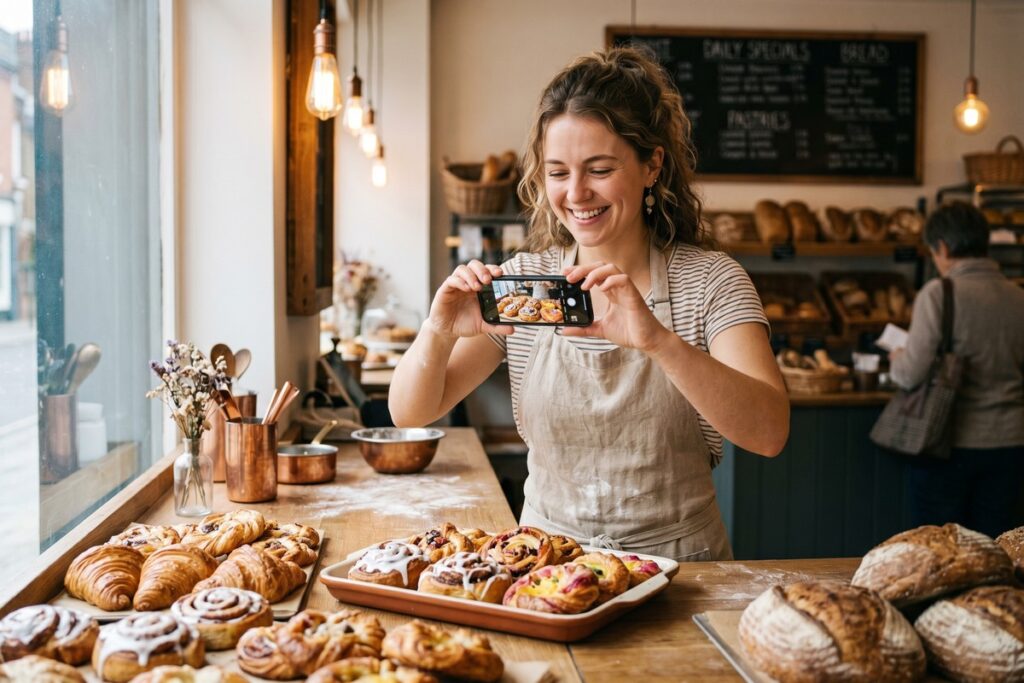
A consistent posting cadence of four posts per week was maintained using only a smartphone and free editing tools. Content pillars included behind-the-scenes baking, customer spotlights (with permission), and time-sensitive offers. Each post included the city name and two to three location-specific hashtags. Within 90 days, Instagram referral traffic to the bakery’s website increased by 180%.
The broader lesson here applies across business types. The article on alternative channels that expand your digital reach documents why over-reliance on social alone creates fragile visibility — and what to build instead. Similarly, understanding organic reach versus paid reach as a long-term strategy helps business owners prioritize sustainable growth over short-term ad spend.
For businesses considering how AI tools can reduce the admin burden of content scheduling and social management, the guide on automating your small business with AI tools covers accessible starting points.
Key Takeaway: A focused Instagram strategy — 4 posts per week with consistent location tagging — drove a 180% increase in social referral traffic in 90 days. Concentrating effort on one platform outperforms a diluted presence across many, as supported by Sprout Social’s engagement research.
Frequently Asked Questions
How long does it take to improve local business online visibility without paid ads?
Most businesses see measurable improvements in Google search impressions within 30–60 days of optimizing their Google Business Profile and correcting citation data. Full results from a content strategy typically materialize within 90 days. Consistency matters more than speed.
What is the most important free tactic for local SEO?
Google Business Profile optimization delivers the fastest and largest impact on local search rankings. A complete profile with photos, accurate categories, and weekly posts consistently outperforms other free tactics in map pack placement. Start here before any other channel.
How many Google reviews does a local business need to rank in the map pack?
There is no fixed minimum, but Whitespark’s ranking factors research indicates that businesses ranking in the top three map pack positions in competitive local markets average 50+ reviews. Review velocity — how quickly new reviews accumulate — also matters alongside total count.
Does social media directly improve Google local search rankings?
No. Social media signals are not a confirmed direct ranking factor in Google’s local algorithm. However, organic social drives brand search volume and referral traffic, both of which correlate with improved rankings. Treat social as a visibility amplifier, not a ranking lever.
What is NAP consistency and why does it matter for local SEO?
NAP stands for Name, Address, and Phone Number. Consistent NAP data across all directories signals to Google that a business’s information is trustworthy. Inconsistencies — even minor ones like “St.” versus “Street” — can suppress map pack rankings. Audit all citations before building new ones.
Can a very small business with no website improve its local business online visibility?
Yes. Google Business Profile, directory citations, and review generation all function independently of a website. However, adding even a basic five-page website with hyperlocal content pages significantly amplifies results. Free website builders such as Google Sites or WordPress.com provide a viable starting point at zero cost.
Sources
- BrightLocal — Local Consumer Review Survey 2024
- Google — Business Profile Optimization Guidelines
- Moz — Local Citations: What They Are and Why They Matter
- Whitespark — Local Search Ranking Factors Report
- BrightLocal — Local Citation Building Tools and Research
- Sprout Social — Social Media Statistics and Engagement Research
- Google — Keyword Planner Tool Overview