
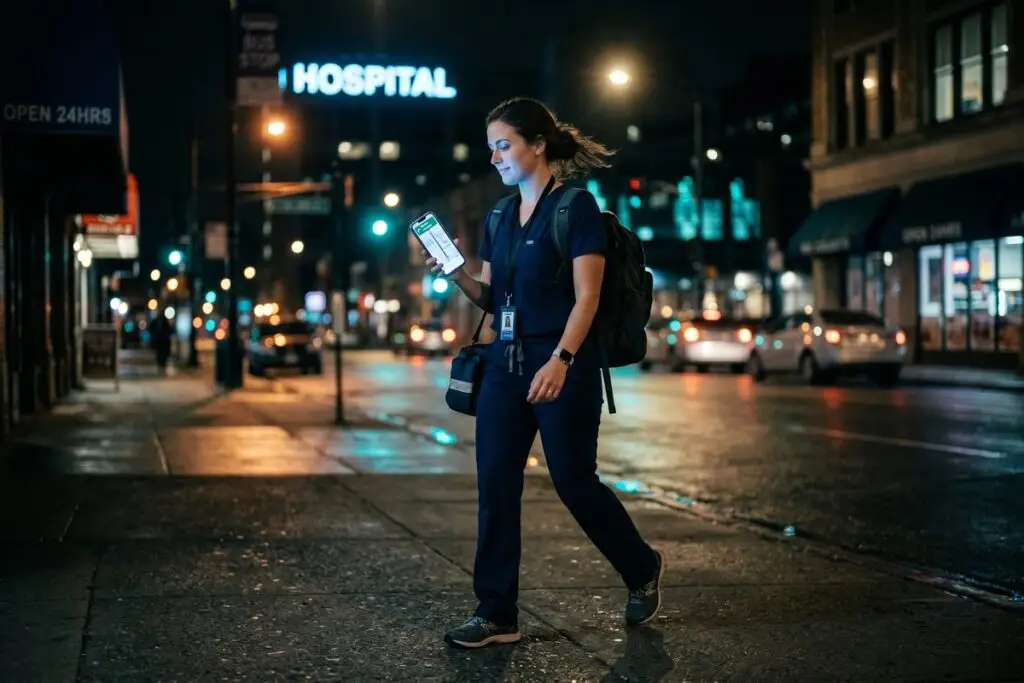
Fact-checked by the digital reach solutions editorial team
Quick Answer
Traveling nurses use phone GPS hacks travel strategies — including offline map caching, custom waypoints, and battery-saver routing — to navigate unfamiliar cities safely during night shifts. As of July 2025, apps like Google Maps and Maps.me allow nurses to pre-download up to 30 days of offline map data, eliminating dead-zone risks in low-signal hospital corridors and rural routes.
Phone GPS hacks travel professionals rely on are not casual tips — they are systematic routines that reduce navigation errors when fatigue and unfamiliarity combine at 2 a.m. According to Travel Nursing Source’s industry guide, more than 300,000 travel nurses are placed across U.S. facilities each year, with the majority rotating into cities they have never visited before.
Night shifts amplify every navigation risk. Poor lighting, reduced foot traffic, and unpredictable traffic patterns make a misconfigured GPS app a genuine safety concern — not merely an inconvenience.
Why Does Standard GPS Fail Traveling Nurses on Night Shifts?
Standard GPS apps fail night-shift nurses primarily because they are optimized for daytime, data-connected commuters — not workers navigating parking garages, hospital campuses, and unfamiliar neighborhoods at 3 a.m. Signal dead zones inside large medical facilities are a documented problem, with steel-reinforced concrete blocking GPS accuracy by up to 90% in basement and interior zones.
Data connectivity is the second failure point. Rural and suburban hospital routes frequently drop to 3G or lose signal entirely. When a nurse is driving a rental car in an unfamiliar city at night, a spinning loading icon on Google Maps is not a minor annoyance — it is a safety hazard.
Battery Drain as a Night-Shift Navigation Risk
GPS is among the heaviest battery consumers on any smartphone. GSMArena’s battery drain analysis shows that continuous GPS use can deplete a modern smartphone battery by 15–25% per hour. A nurse working a 12-hour shift who forgets to charge between legs of a commute faces a dead phone before the shift ends.
Using hidden iPhone accessibility features like Low Power Mode navigation overlays can meaningfully extend GPS session life without disabling location services entirely.
Key Takeaway: Standard GPS apps lose accuracy by up to 90% inside steel-reinforced hospital buildings, and continuous GPS use drains 15–25% of battery per hour — making default navigation settings genuinely dangerous for nurses on 12-hour night rotations.
What Are the Best Phone GPS Hacks Travel Nurses Use Before a Shift?
The most effective phone GPS hacks travel nurses deploy happen before they ever leave their temporary housing — not in the car with one hand on the wheel. Pre-shift preparation is the single highest-impact habit reported by experienced travel nurses.
The core pre-shift GPS routine includes three steps: downloading offline maps, setting custom saved locations, and enabling night-mode display. Google Maps allows users to download entire metro areas for offline use. Google’s official offline maps documentation confirms that downloaded regions remain accessible for up to 30 days without a data connection.
Custom Waypoints and Saved Locations
Saving specific hospital entrances — not just the facility address — is a critical distinction. Large hospital campuses like those operated by HCA Healthcare or Ascension Health can span multiple city blocks with a dozen entry points. Navigating to a campus address may drop a nurse at the wrong entrance, adding a 10-minute walk at shift start.
Apps like Waze and Maps.me allow custom pinned points with personal labels such as “Night Entrance Dock” or “Nurse Parking Lot B.” This takes under two minutes to configure and eliminates the entrance-confusion problem entirely.
| GPS App | Offline Maps | Night Mode | Custom Pins | Battery Impact |
|---|---|---|---|---|
| Google Maps | Up to 30 days | Auto (sunset) | Yes (labeled) | High (15–20%/hr) |
| Waze | No offline mode | Auto | Yes | High (18–25%/hr) |
| Maps.me | Indefinite offline | Manual toggle | Yes (labeled) | Low (8–12%/hr) |
| Apple Maps | Partial (iOS 17+) | Auto | Limited | Medium (12–18%/hr) |
| HERE WeGo | Full offline | Auto | Yes | Low (9–13%/hr) |
Key Takeaway: Downloading offline maps before departure is the single most reliable phone GPS hack for travel nurses — Google Maps stores offline data for up to 30 days, while Maps.me and HERE WeGo offer indefinite offline access with significantly lower battery consumption.
How Do Travel Nurses Manage Battery and Signal During a Night Shift?
Effective battery and signal management during a night shift starts with hardware, not software. A 10,000 mAh portable charger — enough for two to three full phone charges — is standard equipment for experienced travel nurses who treat their phone as a professional tool.
On the software side, the most impactful phone GPS hacks travel nurses use during a shift involve reducing GPS polling frequency. Most navigation apps refresh location every 1 second by default. Switching to a battery-optimized mode — available natively in Android’s Location settings under “Battery Saving” — reduces polling to every 3–5 seconds. This cuts GPS-related battery drain by roughly 40% with no meaningful impact on turn-by-turn accuracy during driving.
Signal Boosting in Low-Coverage Zones
Wi-Fi calling and GPS are separate systems, but nurses often conflate connectivity issues. A hospital’s guest Wi-Fi can support voice calls while GPS satellites — which operate independently of cellular towers — continue functioning normally. Understanding this distinction prevents unnecessary troubleshooting during a shift.
For nurses concerned about phone performance during demanding shifts, reviewing common Android performance mistakes can help eliminate background processes that compete with GPS for system resources.
“Travel nurses face a unique intersection of digital and physical navigation challenges. The nurses who adapt fastest are those who treat their smartphone configuration as part of their pre-shift clinical prep — not an afterthought.”
Key Takeaway: Switching Android location mode to “Battery Saving” reduces GPS drain by approximately 40% with no driving accuracy loss. Paired with a 10,000 mAh portable charger, this combination covers the full navigation demands of a 12-hour shift without a dead battery.
Which Display and Night Mode Settings Make GPS Safer After Dark?
Night display settings on GPS apps directly affect driver safety. Bright white map interfaces cause pupil constriction, reducing a driver’s ability to see dim street signage and pedestrians — a documented concern from NHTSA’s distracted driving research. Every major GPS app now includes an automatic night mode that activates at sunset and switches the interface to dark amber tones.
Beyond the app itself, phone display brightness should drop below 30% during night navigation. Android’s adaptive brightness often overrides this in car mounts near dashboard lights. Locking manual brightness at a low setting — rather than relying on auto-brightness — is a simple but underused phone GPS hack travel nurses consistently recommend in nursing forums.
Do Not Disturb and Focus Mode During Navigation
Notification interruptions during GPS navigation are a distraction risk. Setting up a driving-specific Do Not Disturb profile that silences all non-emergency alerts while keeping navigation audio active is a standard configuration. Both iOS and Android support this natively.
For nurses who want to go further, the comparison between iPhone Focus Mode and Android’s equivalent tools covers exactly how to configure notification filtering without blocking urgent call-in alerts from hospital staffing coordinators.
Key Takeaway: NHTSA research links bright screen interfaces to reduced night vision. Locking phone brightness below 30% and enabling automatic GPS night mode at sunset are safety-critical settings — not cosmetic preferences — for nurses driving unfamiliar routes after dark.
How Do Travel Nurses Protect Their Security While Using GPS in Unfamiliar Cities?
Phone GPS hacks travel nurses rely on must include a security layer — especially when connecting to hospital or hotel Wi-Fi to load maps or update routes mid-shift. Public Wi-Fi on hospital campuses is frequently unsecured, and GPS apps that sync routes through the cloud expose location history to potential interception.
Using a VPN when loading map data on unfamiliar networks is a baseline precaution. The U.S. Cybersecurity and Infrastructure Security Agency (CISA) explicitly recommends VPN use on public networks in its network security guidance for mobile workers. For nurses who handle patient contact information on the same device, this is not optional due diligence.
Location history settings in Google Maps and Apple Maps should be audited before each travel assignment. Both platforms store granular movement data by default. Disabling location history — while keeping real-time navigation active — is a setting most users never configure. A practical guide to mobile security on public Wi-Fi covers the exact steps for both iOS and Android devices.
Key Takeaway: CISA recommends VPN use on all public networks — a guideline travel nurses should apply when loading GPS data on hospital Wi-Fi. Disabling location history while keeping real-time navigation active protects movement data across a 13-week average travel assignment without affecting navigation performance.
Frequently Asked Questions
What is the best GPS app for travel nurses working night shifts?
Maps.me and HERE WeGo are the top choices for offline reliability, consuming roughly 8–13% battery per hour versus Google Maps at 15–20%. Google Maps remains the most feature-rich option when data connectivity is reliable, but offline-first apps are safer for rural hospital assignments.
How do I download offline maps before a travel nursing shift?
In Google Maps, tap your profile icon, select “Offline Maps,” then “Select Your Own Map” and draw a box around your assigned city. The download takes 2–5 minutes on Wi-Fi and stores up to 30 days of data. Maps.me and HERE WeGo allow full country-level downloads with no expiration date.
How do travel nurses use phone GPS hacks travel professionals recommend for battery life?
The most effective combination is: switch Android location to “Battery Saving” mode, lock screen brightness below 30%, use an offline-first GPS app, and carry a 10,000 mAh power bank. This configuration can extend GPS session life from 4–5 hours to 8–10 hours on a single charge.
Is it safe to use GPS on hospital Wi-Fi during a nursing shift?
Hospital guest Wi-Fi is typically unsecured and should not be used to sync location data or route history without a VPN. Real-time GPS navigation uses satellite signals and does not require Wi-Fi, so the safest approach is to load all map data before the shift using a trusted home or hotspot connection.
Can travel nurses use Apple Maps offline the same way as Google Maps?
Apple Maps added limited offline map support in iOS 17, but its offline capability is less comprehensive than Google Maps or Maps.me. Nurses using iPhones can download specific areas, but the offline region size is smaller and the feature is less mature. Google Maps or Maps.me remain more reliable for overnight offline navigation.
What Focus Mode settings should travel nurses use during GPS navigation?
Configure a custom Focus Mode profile that silences social media and email notifications while allowing calls from saved contacts — specifically hospital staffing coordinators. Navigation audio should remain active. Both iOS Focus Mode and Android’s equivalent support per-app and per-contact exception lists that take under five minutes to configure.
Sources
- Travel Nursing Source — Travel Nursing Industry Guide
- Google Support — Download Areas and Navigate Offline
- NHTSA — Distracted Driving Road Safety
- CISA — Securing Network Infrastructure Devices
- GSMArena — GPS Battery Drain Glossary
- American Nurses Association — Nursing Workforce Data
- Bureau of Labor Statistics — Registered Nurses Occupational Outlook